
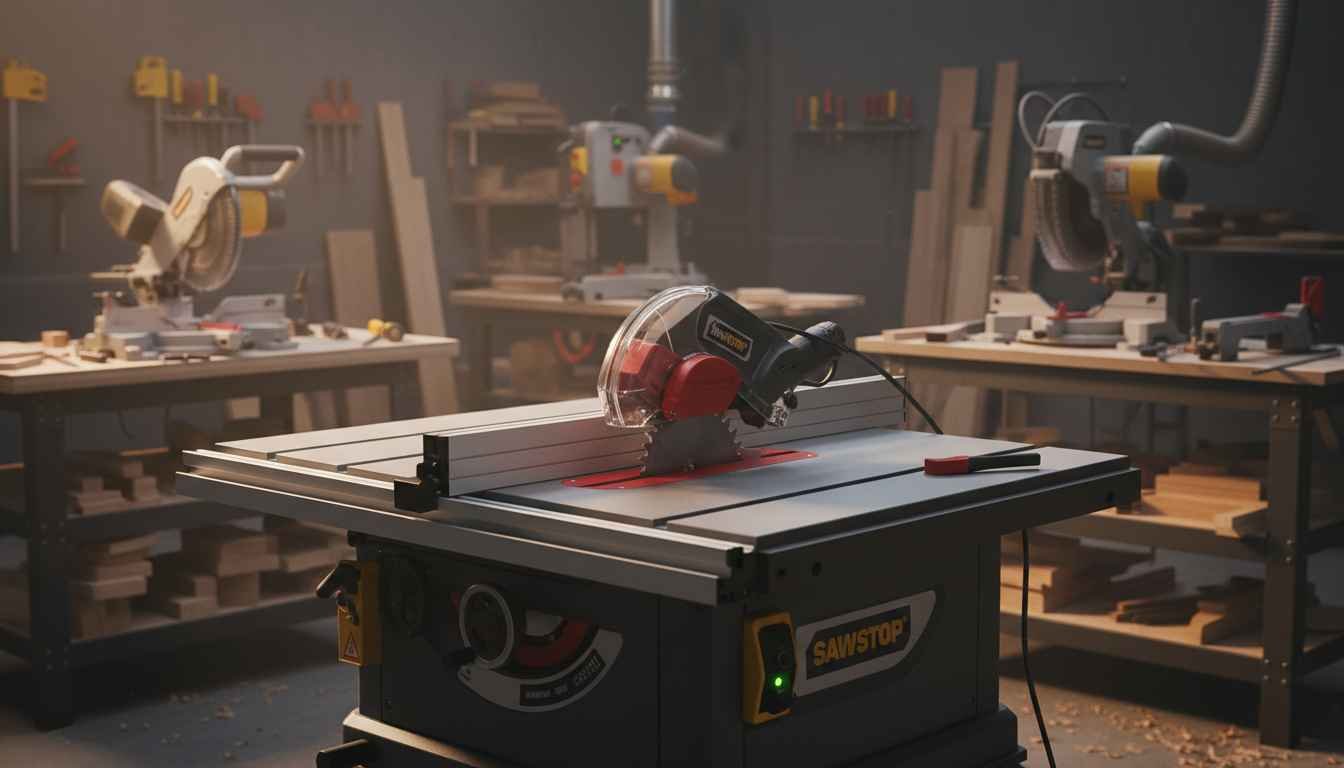
A journey of a thousand miles begins with a single step, and in woodworking, that first step is often the safety measures we take. For decades, table saws have posed a significant risk to craftsmen, hobbyists, and professionals alike. The innovation of SawStop technology has changed the landscape of safety in woodworking, dramatically reducing the risk of severe injuries from blade contact. But how far can this technology extend beyond its original home in table saws, and what does it mean for the future of workshop safety?
To understand the implications of SawStop technology in other saws, we first need to grasp what it is and how it works. SawStop employs a patented system that can detect electrical conductivity in human skin. When a blade comes into contact with a person, the system instantly stops the blade, retracting it below the table in milliseconds. This rapid reaction can prevent catastrophic injuries that would otherwise require extensive medical intervention.
Quick Definitions
SawStop: A safety technology that stops a saw blade within milliseconds upon detecting human skin contact.
Blade Retraction System: The mechanism that pulls the saw blade below the table during a SawStop activation.
Conductivity Detection: A method to sense electrical differences in materials, key to SawStop’s safety response.
The primary application of SawStop has always been in table saws, but innovation doesn’t stop at a single tool. Manufacturers and enthusiasts have explored integrating this life-saving technology into other saws such as radial arm saws, miter saws, and even band saws. While the adaptation presents unique challenges, the potential safety benefits are substantial. Each saw type has its own operational mechanics, and retrofitting SawStop technology requires precise engineering to ensure reliability without compromising performance.
Radial arm saws, for instance, involve horizontal movement of the blade across the workpiece. Adapting SawStop here demands an advanced detection system that can account for the blade’s path and speed. Miter saws, widely used for precise angle cuts in carpentry and framing, have limited space around the blade guard, complicating the installation of retraction mechanisms. Band saws present a different challenge entirely; the continuous loop blade requires a detection system that can monitor the entire blade length, ensuring safety across the moving cutting edge.
Despite these challenges, there have been promising advancements. Engineers are experimenting with modular safety units that can be applied across various saws. These units include compact sensors, high-speed actuators, and advanced circuitry capable of performing the same lifesaving functions as the original SawStop system. Early testing suggests that incorporating this technology into miter saws and radial arm saws is feasible, though mass adoption remains limited due to cost and design constraints.
Integrating SawStop technology beyond table saws also raises questions about practicality. The system adds weight and complexity to tools, which can affect handling and precision. Moreover, replacement cartridges for the braking system carry an additional recurring cost. While these considerations may seem minor compared to preventing severe injuries, they play a role in adoption decisions among hobbyists and small workshop operators. For larger commercial operations, however, the long-term benefits often outweigh the short-term challenges.
One of the exciting aspects of expanding SawStop technology is the potential for hybrid designs. Imagine a table saw that can communicate with a miter saw in the same workshop, creating a unified safety network. Sensors could track blade positions, operational status, and even detect multiple users in proximity, offering real-time alerts and interventions. While this is currently conceptual, the trajectory of smart workshop technology aligns perfectly with SawStop’s mission to prioritize safety without compromising productivity.
The broader implications extend into safety standards and regulations. If SawStop technology proves reliable across multiple saw types, industry standards may evolve to require advanced blade detection mechanisms in all power saws. This shift could dramatically reduce woodworking injuries and influence insurance policies, liability considerations, and even educational practices in trade schools. Safety in workshops could move from reactive to proactive, reshaping the entire approach to power tool usage.
It’s important to note that SawStop technology, while revolutionary, isn’t foolproof. Certain materials, environmental conditions, or electrical anomalies can interfere with detection. Users must still exercise caution and adhere to conventional safety practices, such as using push sticks, wearing protective gear, and maintaining sharp blades. Additionally, retrofitted or experimental SawStop systems in non-table saws may not have the same reliability as the original designs, making professional evaluation essential.
SC Media has highlighted numerous technological innovations in industrial safety, including adaptations of SawStop for niche applications. These insights demonstrate the growing interest in extending the benefits of such systems, not just in woodworking but potentially in broader manufacturing environments where blade contact poses a significant risk.
Workout Routine Breakdown of SawStop Technology Adoption
Think of implementing SawStop in other saws as a disciplined workout routine. Each step strengthens your workshop safety “muscles,” ensuring readiness for unexpected accidents. Here’s a breakdown:
Warm-Up: Understanding Core Mechanics
Before attempting any modifications, familiarize yourself with the saw’s operation and blade dynamics. Study motor speeds, blade materials, and workpiece interactions. This foundational knowledge is critical to ensure any safety system integrates smoothly without causing operational issues.
Main Set: Installation and Testing
Careful installation of sensors, actuators, and detection circuitry mirrors a focused main exercise set. Precision is key; misaligned sensors or poorly calibrated actuators can nullify the safety benefits. Test extensively with controlled scenarios, simulating blade contact with conductive materials before trusting the system in live environments.
Cool-Down: Maintenance and Monitoring
Just like a cool-down period after exercise, maintaining SawStop systems in any saw requires regular checks. Replace braking cartridges promptly, inspect sensors for dust accumulation, and verify electrical connections. Continuous monitoring ensures the system responds reliably when needed.
Optional Stretch: Innovation and Expansion
Advanced users can explore networked safety systems, integrating multiple saws into a centralized monitoring setup. This step, while complex, expands the protective coverage across your workshop, akin to stretching your capabilities and achieving a new level of safety proficiency.
Potential Drawbacks and Who Should Avoid This
While SawStop technology offers life-saving potential, it’s not suitable for everyone. Workshops with limited budgets may find the cost prohibitive. Hobbyists using low-frequency saws might not justify the investment, especially for tools rarely used. Additionally, DIY retrofitting carries risk; improper installation could render the system ineffective or even damage the saw.
Professional woodworkers or educational institutions, on the other hand, benefit greatly from adopting SawStop in multiple saw types. The reduction in injury risk alone justifies the expense and effort. Ultimately, weighing cost, reliability, and frequency of use is essential before integrating SawStop technology into non-table saws.
Final Thoughts
The journey of expanding SawStop technology beyond table saws is a testament to human ingenuity and commitment to safety. While challenges in adaptation, cost, and practicality remain, the potential to drastically reduce injuries in woodworking and industrial environments is undeniable. By viewing the process as a structured “workout routine,” woodworkers and engineers can approach implementation methodically, ensuring both safety and performance are optimized. As technology evolves, the dream of universally safe saws may become a reality, empowering craftsmen to create without fear and protecting countless lives in the process.