
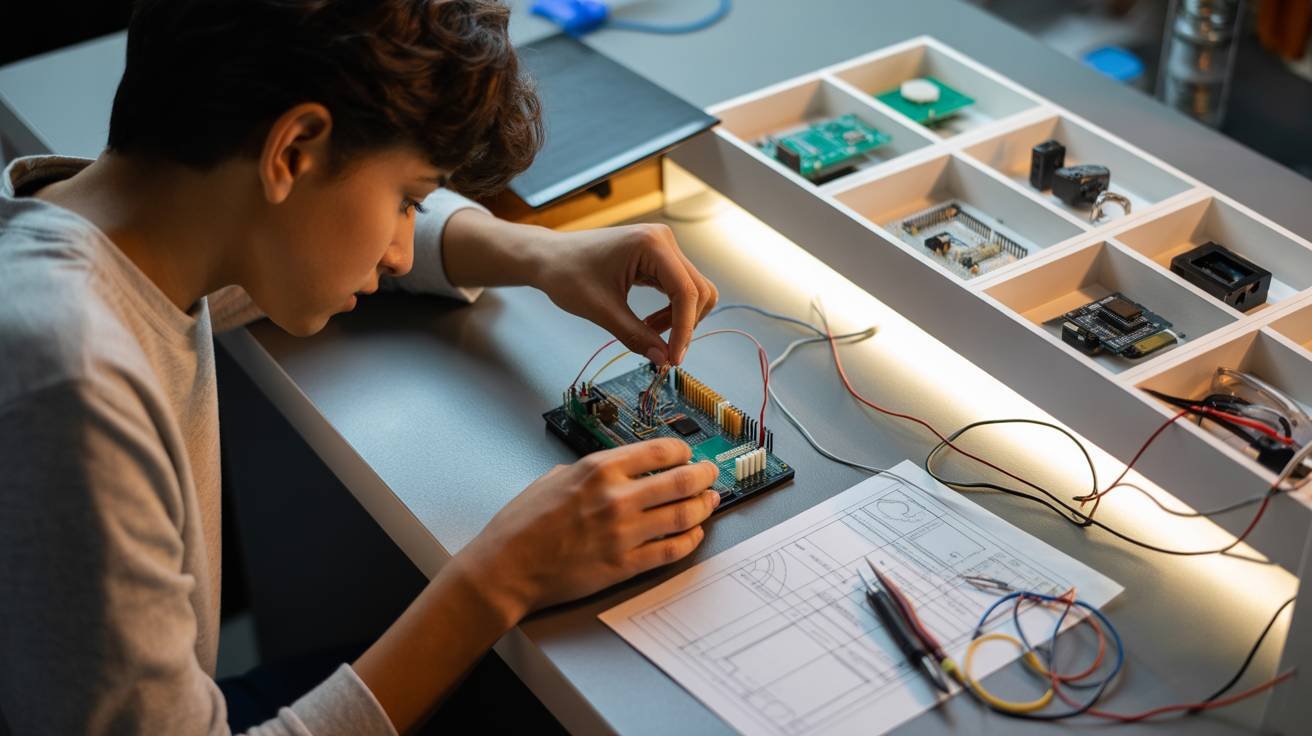
DIY projects are one of the most effective ways to build real problem-solving and analytical thinking skills, because they force you to work through genuine problems with your hands, your budget, and your patience all involved. Unlike a worksheet, a project that goes wrong stays wrong until you understand why — and that moment of understanding is exactly where analytical thinking grows. This guide explains how DIY projects develop these skills, which types of projects work best, and how to get the most learning out of every build.
Why DIY Projects Build Problem-Solving Skills
Every DIY project is a chain of small problems: measuring accurately, choosing materials, sequencing steps, and recovering when something does not fit. You cannot skip the reasoning stage, because the physical result exposes it. A shelf that wobbles tells you the joints, the level, or the wall fixings were misjudged — and finding which one is a pure exercise in analysis: observe, form a hypothesis, test it, and adjust.
This cycle — attempt, feedback, diagnosis, correction — is the same cycle used in science, engineering, and everyday professional work. Repeating it on practical projects turns it into a habit of mind rather than a classroom exercise.
How DIY Projects Foster Analytical Thinking
Analytical thinking means breaking a complex whole into parts you can understand and act on. DIY work demands this constantly. Before starting, you break a finished object into components and steps. During the build, you compare what is happening against what you expected, which is the heart of analysis. Afterwards, you can review which decisions caused which results.
Projects also teach estimation and trade-offs. Materials cost money and time is limited, so you learn to weigh options: a stronger joint that takes longer, a cheaper material that needs more care. Weighing competing factors against a real outcome is analytical thinking in its most practical form — the same skill our guide on developing problem-solving and analytical thinking skills explores from the study side.
The Role of DIY Projects in Developing Creativity
Problem-solving is not only about finding the one correct answer; often it is about inventing a workable answer from what is available. DIY projects regularly present shortages — a missing tool, a discontinued part, a space that is almost the right size. Solving those moments requires improvisation grounded in understanding: you must know why the original plan worked before you can safely change it. That blend of knowledge and invention is practical creativity, and it transfers directly to school and work problems where the textbook solution is not available.
Practical Benefits in Real-Life Scenarios
The benefits show up outside the workshop too. People who regularly complete DIY projects tend to approach household problems, study problems, and work problems with more patience and structure: define the problem, gather what you need, try the simplest fix first, and check the result. Confidence grows alongside competence, because each finished project is visible proof that a confusing problem can be understood and solved step by step.
For students, this matters during revision and projects alike. The planning habits built during DIY work — listing materials, sequencing steps, checking progress — mirror the habits behind organising notes for effective review and revision, and they make long assignments feel manageable instead of overwhelming.
Building Collaboration Through Group Projects
Group DIY projects add a second layer of learning: communication. A shared build forces you to explain your reasoning, divide tasks according to strengths, and reconcile different approaches when plans conflict. Disagreements about the best method are not a problem to avoid — they are analysis done out loud, and resolving them teaches the negotiation and justification skills that classrooms rarely practise directly.
Building Confidence Through DIY Challenges
Confidence in problem-solving comes from evidence, and finished projects provide it. Start with small, completable builds — a repaired chair, a simple storage box, a planted herb frame — and increase difficulty gradually. Each success makes the next unfamiliar problem feel less intimidating, because you have proof that confusion at the start is normal and temporary. If a project fails, treat the failure as data: the diagnosis of what went wrong is itself one of the most valuable thinking exercises the project can offer.
Getting Started: Choosing Your First Projects
- Begin with repairs: fixing something broken gives you a clear goal and a built-in test of success.
- Choose projects with visible stages: builds you can check as you go teach sequencing and self-correction.
- Keep a simple project notebook: note your plan, what changed, and what you would do differently — this reflection step is where much of the learning happens.
- Raise difficulty gradually: add one new tool or technique per project rather than all at once.
Final Thoughts
DIY projects improve problem-solving and analytical thinking because they make thinking visible: every decision leaves evidence you can examine. Choose projects that stretch you slightly, reflect on what each build taught you, and let the difficulty grow over time. The skills compound — and they stay with you long after the project itself is finished. If you are building these habits as part of a wider study routine, our guide on how to improve critical thinking skills is the natural next step.