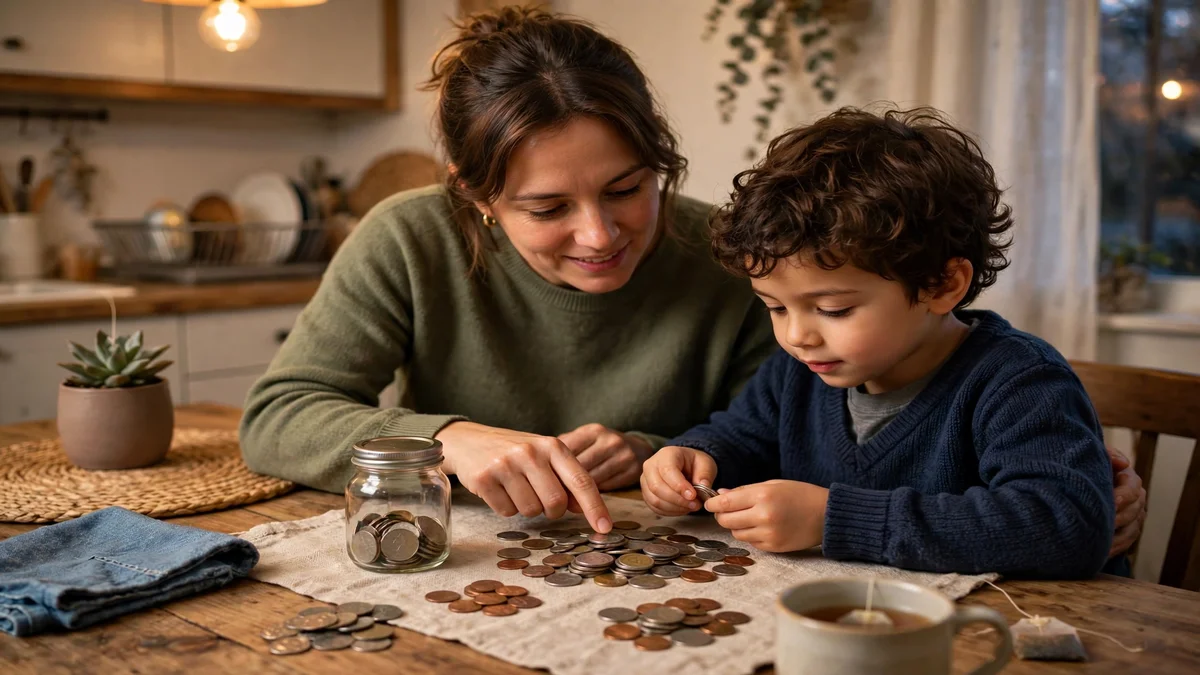
To teach kids money skills, skip the lecture and start with real coins in a real jar. Children learn about money by handling it, making small choices, and seeing what happens next. A child who saves for a toy, waits a week, and finally buys it understands value in a way no worksheet can teach.
Money habits form early. By the time children are seven or eight, they already have ideas about spending, saving, and what things are worth, picked up from watching the adults around them. That is good news. It means everyday moments, the weekly shop, a birthday gift, a broken toy, are already teaching. Your job is to make those lessons deliberate instead of accidental.
Start With Three Jars, Not One Piggy Bank
Give your child three clear jars or envelopes: spend, save, and share. Every time money arrives, whether pocket money, a birthday gift, or a small payment for a job, split it between the three. A simple split works well: half to spend, most of the rest to save, and a little to share.
The jars make abstract ideas visible. The spend jar empties fast, and that is the lesson. The save jar grows slowly, and watching it grow teaches patience better than any speech about delayed gratification. The share jar teaches that money is not only for us, and choosing where it goes is a decision worth thinking about.
Keep the jars somewhere your child can see them. A shelf in the bedroom beats a drawer nobody opens. When the save jar fills up, count it together. Counting is part of the lesson, and the total at the end is a small celebration your child earned.
Let Them Make Small Spending Mistakes
The hardest part of teaching money skills is standing back while your child spends badly. A cheap toy that breaks in a day feels like a waste to you, but to your child it is a lesson that sticks. If you rescue every bad purchase, the lesson never lands.
Set a rule instead: once the spend jar is empty, it stays empty until the next payday. No top-ups, no loans from the save jar. That single rule teaches budgeting more honestly than a month of talks about it, because the consequence is real and immediate.
Talk about the purchase afterwards, without scolding. Ask what they liked about it, whether it was worth the money, and what they would do differently. Children who reflect on a purchase learn faster than children who are simply told they chose wrong. The same patient approach helps in other areas too. Our guide on teaching children problem-solving skills uses the same idea: let them think it through, then talk it over together.
Make Saving Visible and Worth Waiting For
Saving only works when the goal feels real. Help your child pick one thing to save for, something they want enough to wait for. Write the price on a chart and colour in progress as the jar fills. A chart on the wall turns a vague idea into something they check every morning.
Match small milestones. When the jar reaches halfway, you might add a small bonus, not as a bribe but as interest. Explain it simply: money saved can grow, just like money in a bank grows. That is the seed of understanding how savings and interest work, planted years before they ever open an account.
Keep the goal in reach. A goal that takes a year to reach will crush a young child’s motivation. For a five-year-old, two weeks is a long time. For a 10-year-old, two months is fair. Match the wait to the age, and raise it slowly as they grow.
Teach the Difference Between Wants and Needs
Sorting wants from needs is a game children enjoy. At the supermarket, ask them to sort the trolley: food and shoes are needs, sweets and a new game are wants. They will argue about the borderline items, and the argument is the lesson. Real life has grey areas, and learning to spot them is a skill, not a rule to memorise.
Use their own wishes as examples. A new bike might be a need if the old one broke, or a want if the old one still works. Talking it through teaches them to pause before buying, and that pause is the most valuable money habit of all. Most adult overspending happens because nobody paused.
Be honest about your own choices too. When you decide not to buy something, say why out loud. “We are saving for the holiday, so I am leaving this for now.” Children copy what they see far more than what they are told, and a parent who models patient choices is teaching every single day.
Give Pocket Money a Real Job to Do
Pocket money works best when it has a purpose. Instead of random coins, agree on a small weekly amount and one thing it must cover, like a school snack or a magazine. That turns pocket money into a tiny budget, and your child learns to plan across a week instead of spending it all on Monday.
Pay it on the same day every week. Regularity matters. A child who can rely on Friday’s money can plan for it, and planning is the skill. If the money arrives randomly, there is nothing to plan around, and the lesson disappears.
Do not tie all pocket money to chores. Household jobs are part of family life, not paid work, and paying for every bed made teaches the wrong lesson. Extra jobs beyond the usual, like washing the car or helping with a big clear-out, can earn extra money. That distinction teaches the difference between duty and earning, which is worth knowing early.
Talk About Money Openly, at Their Level
Many parents avoid money talk because it feels awkward or private. Children notice the silence and fill it with guesses, often wrong ones. You do not need to share your salary or your worries. You only need to answer honest questions honestly and in words they understand.
When your child asks why you cannot buy something, give a real reason. “It is not in this month’s budget” is better than “we cannot afford it” when the truth is about priorities. It teaches that money is about choices, not just about having enough.
Stories work well too. Tell them about the first thing you saved for, or a purchase you regretted. A short, honest story does more than a lecture, and it gives them permission to talk about money without embarrassment. Building that comfort early pays off for years. A calm daily habit like a reading routine for your child works the same way: small, regular, and part of family life rather than a special event.
Money Lessons That Last
Teaching kids money skills is not one big talk. It is three jars on a shelf, a weekly amount they plan around, a few mistakes they are allowed to make, and honest answers when they ask. Small habits, repeated, beat big lessons every time.
Start this week. Set up the jars, agree on a first saving goal, and let your child make one small choice with real money. Then watch what happens. The skills they build now, patience, planning, and the habit of pausing before spending, will still be working for them long after the jars are gone. And if you want more ideas for raising a thoughtful child, read our guide on helping a shy child build confidence, creating a safe and stimulating learning environment at home, encouraging children’s curiosity about science and nature, supporting cognitive and academic growth in young learners, and encouraging independence, accountability, and self-discipline in kids.